Reading Slump: How to Find Your Way Back to a Book
Reading slump: notice what changed, set aside a book that feels like work, and choose one gentle next step without turning reading into another goal.
By Ultimate Book Tracker by Cosmo Suite · Editorial policy
Published · 8 min read
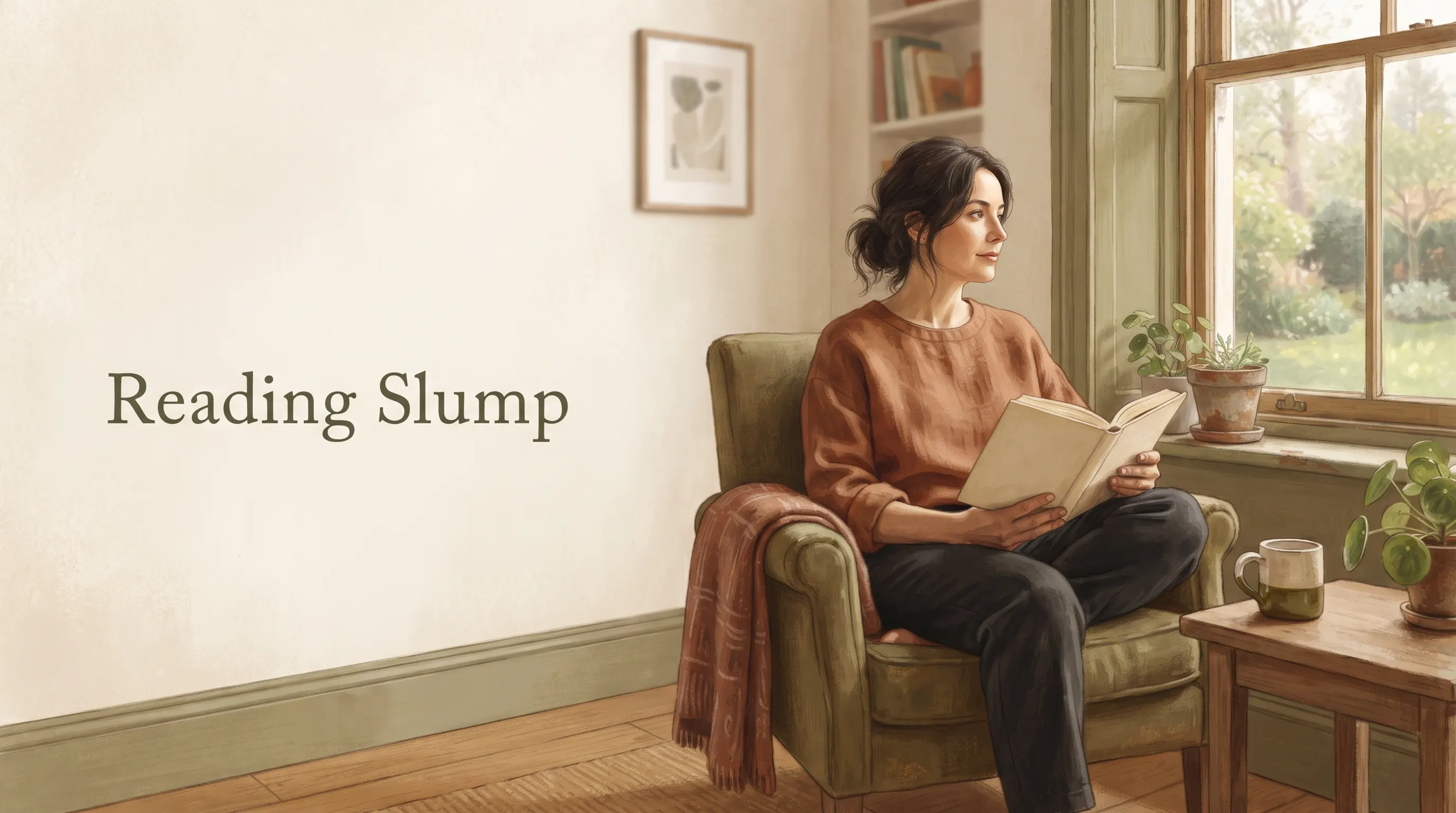
You open the book you were excited to read. A few pages pass, then you check your phone, make tea, or decide to try another title. If this keeps happening, it can feel as if reading has stopped being yours for a while.
A reading slump is a stretch when your usual way of reading feels hard to return to. The way through may be a different book, a different format, a pause, or less pressure to finish. Start by noticing what feels stuck. That gives you a more useful next move than adding another reading goal.
The Short Version
A reading slump is a period when picking up a book feels harder than it normally does. Try to spot whether the problem is the current book, the format, outside pressure, or reading itself. Then make one small choice: pause, switch, reread, or leave reading alone for now. You do not need a quota to come back.
Reading slump choices at a glance
Choose a response that matches what you notice. If one book feels heavy, setting it aside may be enough. If the pressure to keep up is the problem, remove the deadline or challenge. If you do not want to read at all, a break can be a reasonable choice. There is no single fix that fits every reader.
| What you notice | A small next step | What it changes |
|---|---|---|
| One book feels like work | Pause it or mark it DNF | Removes the obligation to finish this title |
| Your usual genre feels stale | Browse outside your usual shelf | Gives you a different kind of story or subject |
| A printed page feels hard to focus on | Try audio or an e-book, if available | Changes the way the words reach you |
| Your TBR or challenge feels like homework | Hide the list for now | Makes the next choice smaller |
| Nothing sounds good | Take a break from books | Lets reading stay optional |
Use these as options and choose what fits. In a Book Riot essay, the writer describes DNFing, rereading, and stepping away when reading starts to feel like work. Booksellers at Rediscovered Books and Old Town Books also discuss changing format, returning to a familiar book, or taking time off. Keep the option that sounds kind to your current self.

Work out what feels different
Before choosing a fix, name the part that changed. You might still want stories but feel tired of your current book. You might want to read, but the usual format is inconvenient. Or you may simply not want a book in your free time right now. These are different situations, so they deserve different responses.
Ask yourself what you remember from the last time reading felt easy. Was it a certain kind of book, a familiar series, a quiet place, or a format you could fit into the day? You do not have to recreate that moment exactly. The question is a way to find a clue, not a standard you must meet.
It can also help to notice what came just before the slump. Perhaps you finished a long book, set aside a title that had been recommended to you, or found yourself trying to keep pace with a group. That timing gives you a detail to consider when you choose what to do next.
Enjoyment can also shift from one reading experience to another. A 2026 study asked 76 adults to read book synopses and found that momentary enjoyment was associated with different reading behaviors. It did not study slumps or their causes. Treat the way one book feels as a clue about that reading moment, not a verdict on every book you might choose (Parker and colleagues, “Situational Enjoyment Is Associated with Gaze Behaviour During Reading”).
If a particular book is the problem, leave it open on your shelf or add a short note about where you stopped. If reading feels like another obligation, take away the target first. If your attention is elsewhere, you are allowed to let it be elsewhere.
For some readers, the TBR pile adds noise because every unread title looks like another promise. Hide the list while you decide what sounds good today. If a book club or reading challenge is adding pressure, step back from its list for a while. You can return when it feels interesting again, or leave it behind.
Give the next book a smaller job
When you want to read but feel unsure where to start, lower the stakes of the next choice. Pick something because it suits your mood today, not because it will repair your reading life or help you catch up. A short story, a familiar reread, a graphic novel, or an audiobook can all be valid next choices.
You can also read a little and stop without deciding whether the book is a success. A few pages are enough to find out whether you want more today. If the answer is no, close it. You can return later, try another title, or leave the whole question for another day.
Readers writing about their own slumps often describe changing one thing at a time. In the Book Riot essay, the author discusses setting aside books that do not hold her attention and revisiting a favorite. The bookseller at Rediscovered Books describes audio as one way to keep engaging with books when print does not fit. These are personal accounts, not guarantees. Use them as a menu of possibilities.
There is also relevant research on choice, though it does not study slumps. In two 2025 experiments, 49 and 80 adults aged 18 to 24 read short extracts or genres they could choose, or ones selected for them. The authors reported higher enjoyment in the choice conditions. That gives you a reason to choose by interest when you try again; it cannot predict how any one book will feel (Bains and colleagues, "Providing Choice Enhances Reading Motivation").
Avoid building a new challenge out of the recovery. A daily page count or a stack of replacement books can make the slump feel like a test with a score. If a small routine feels comforting, keep it loose. If it starts to feel like a duty, drop it.
Take a break without declaring reading over
You can stop reading for a while without making a decision about who you are as a reader. A pause is useful when even browsing titles feels tiring or when every book reminds you of what you think you should be doing. Spend the time however you like.
Put the current book somewhere you can find it, or leave it in the place where you usually read. If you prefer not to see it, move it out of sight. The goal is to make the choice feel neutral. You can return when the idea of opening a book sounds pleasant again.
Some readers feel anxious when they do not finish a book. A DNF note can make stopping feel more settled: title, where you stopped, and whether you might try again. You can also write nothing. Keeping a record is only useful if it removes a small annoyance instead of creating another task.
There is no need to measure your break against someone else's reading pace. Social posts, annual goals, and group lists can make other people's reading visible. They do not tell you what your own free time needs. You can mute a challenge, hide a TBR list, or keep reading privately.
Keep a small record of what changed
If you want to understand a recurring reading slump, write down a few details while they are fresh. Note when you first noticed the change, what you had been reading just before it, and when reading began to feel easier again. This gives you a timeline to look back on without turning it into a rating of your effort.
| Note | What to write |
|---|---|
| When the change started | The date or season when reading began to feel different |
| What came before | A title, format, reading challenge, or change in routine you remember |
| What I tried | A pause, a different format, a reread, or another choice |
| What happened next | Whether you wanted to read again, and what sounded appealing |
You do not need to fill every row. A few words are enough, and you can leave the record unfinished. The point is to make your next decision easier if the same feeling returns. You may notice that a certain kind of book often feels like a good reset, or that taking pressure away is what helps you return.
For example, the first entry can be as broad as a season if the exact date is unclear. Leave other fields blank until you have something useful to add.
If you already keep a private record of books, the book tracker spreadsheet guide explains one way to keep titles and notes together. You can also use a paper notebook, a note on your phone, or no system at all. Choose the option you will not resent maintaining.

Return by choice, not by quota
When reading starts to sound appealing again, follow that interest before setting a target. Pick the book you want to open, even if it is not the one you planned to read next. You can stop after a page or stay longer. The useful signal is whether you want to continue, not how much you finish.
If the first choice does not work, it has still given you information. Maybe you want a different voice, a shorter piece, a familiar story, or a break after all. Switch without turning that choice into proof that the slump is back.
The reading slump advice in the linked essays varies because readers vary. Some return through a reread. Others change format, choose a different kind of book, or leave books alone for a while. Your next step can be small enough to change again.
Ultimate Book Tracker by Cosmo Suite publishes this guide. The about page identifies the publisher, and the editorial policy explains source checks and corrections. If reading still feels like a chore, you can close the book and come back when you want to.
Frequently asked questions
What should I do when I am in a reading slump?
Start by naming what feels difficult: the book, the format, the pressure to keep up, or the wish to read at all. Then try one small change, such as setting the current book aside, choosing a shorter piece, or taking a break.
How long does a reading slump last?
There is no set length. A reading slump can pass quickly or last for a while. You do not need to choose a deadline; notice when reading begins to feel welcome again.
Is it okay to stop reading a book during a slump?
Yes. You can pause or stop a book that is not working for you. Marking it DNF or leaving a note can help you remember where you stopped if you want to return later.
Can rereading help with a reading slump?
It can be a comfortable option if a familiar book sounds appealing. You can also choose a new genre, a different format, a short piece, or no book for now.
What is the 50-page rule for reading?
It is an informal stopping point some readers use, not a universal rule. You can stop earlier, later, or whenever you know a book is not for you.
Sources
Keep reading
Reading Life
TBR List Template: Columns That Help You Choose
TBR list template with practical columns for what you own, what you want next, and why it caught your eye. Use a simple view to pick a book.
· 8 min read

Reading Life
Reading Nook Ideas for Small Spaces: Make a Corner Work
Reading nook ideas for small spaces can start with a chair you own. Add useful light, a place for your book, and one detail that feels like you.
· 8 min read
Reading Life
What Does DNF Mean in Books? (And How to Track the Ones You Quit)
What does DNF mean in books? It means Did Not Finish. Learn when readers use it, how it differs from pausing, and how to record the page where you stopped.
· 8 min read
